Samudra Manthan (Churning of Ocean)
Archaeological evidence has revealed that Brahmanical storytellers falsely portrayed the existence of Mahabharata and Hindu temples in Cambodia. However, archaeology indicates the artistry associated with the Churning of the Ocean (Samudra Manthan) actually originated from Buddhist Jataka tales. Imagine how much these Brahmanical storytellers have misled Indians by claiming this is a Hindu story?
The Vishnu Purana, often cited to validate the narrative of Samudra Manthan, mentions Yavanas, Turks, Muslim rulers, and even the British, indicating it was written during the British rule in India. Meanwhile, Buddhist Jataka tales are more than 2,200 years old, and artworks depicting them can be found from the 5th-6th centuries up to the 12th century in Buddhist countries. Furthermore, the story of Shiva drinking the poison that turned his throat blue, supposedly from the churning of the ocean, is actually copied from Buddhist Jataka tales. In reality, it was Bodhisattva Vajrapani who had to drink poison-laced nectar and was punished for it.

Ancient Buddhist sculpture in sandstone (left) vs. copied Hindu version on paper
Hindu Mythology: Shiva, Vishnu, & Devis (Female Goddesses)
The factual Buddha became the mythological Shiva, Vishnu, and Devis (female goddesses) during the 12th-16th centuries.

Ancient Buddha became Shiva in the 16th Century ACE.
The Buddha as Hindu Vishnu
In spite of the isolated presence of a negative association of the Buddha avatar with demons and heresy, some Hindus in the fake Puranic period came to accept the Buddha's teaching as being positive. Thus, the Hindu Varaha Purana and Matsya Purana associate the Buddha as Vishnu.
The Devibhagavata Purana states Vishnu "became incarnate as the Buddha in order to stop the slaughter of animals and to destroy the sacrifices of the wicked.”
Likewise, the Vaishnava Poet Jayadeva (12th century) states Vishnu became Buddha out of compassion for animals and to end bloody sacrifice.

Ancient Buddha became Vishnu after the 12th century ACE.
Sama Jataka as Sravan Kumar Katha
This is perhaps the most famous Jataka involving blind parents. It is the third story in the Mahanipata Jataka (the collection of the last 10 births).
The Story: The Bodhisattva (future Buddha) is born as Sāma, the son of two pious hermits, Dukulaka and Parika. When Sāma is 16, his parents lose their sight after a poisonous snake sprays venom into their eyes while they are seeking shelter from a storm.
The Conflict: Sāma dedicates his life to their care, fetching water and food daily. One day, while drawing water at a river, he is accidentally shot by a poisoned arrow from King Piliyakkha of Benares, who was hunting deer.
The Resolution: As Sāma lies dying, he expresses concern only for his blind, helpless parents. The King, overcome with remorse, brings the parents to their son. Through an "Act of Truth" performed by the parents and a goddess (Bahusodari), Sāma is miraculously healed and his parents' sight is restored.
Ancient Buddhist Suvanna Sāma Jātaka (left) copied in the Hindu Sravan Kumar Katha (right)
Buddha as Brahma
In Buddhism, Brahma is not a creator god but a high-ranking deity and protector of the Dhamma. He acknowledges the Buddha’s superior wisdom and serves as the Buddha’s disciple. Brahma Sahampati, the most prominent Brahma, was a former disciple of Kāśyapa Buddha (a past Buddha) and later urges Gautama Buddha to preach.

Bodhisattva Rahul vs. Hanuman Myth
The sculpture of Bodhisattva Rahula pulling open his chest to reveal the Buddha's face symbolizes Rahula (the Buddha’s son) as a devoted disciple holding his father’s teachings within his heart. It also signifies the Buddha nature inside all beings.
Later, Hindus copied with the myth of Hanuman, who tears open his chest to reveal Lord Rama and Sita.

Buddhist Vasudeva with Dhamma Chakra vs. Krishna
Vasudeva in Buddhist Traditions
Buddhist texts, specifically the Jataka tales (stories of the Buddha's previous lives), often "co-opted" figures from popular local legends.
As a Disciple: In some Buddhist legends, Vasudeva is portrayed as a character who met and was taught by the Buddha in a past life.
As an Emanation: In Mahayana Buddhism, some texts (like the Kāraṇḍavyūha Sūtra) suggest Vasudeva was actually manifestations of Avalokiteśvara Bodhisattva.
The Ghata Jataka: In this Buddhist story, Vasudeva is copied in the mythological Hindu epic Mahabharata.

Left: Vāsudeva on a coin of Agathocies of Bactria, circa 190–180 BCE. Right: Krishna on paper
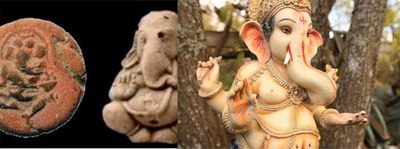
Hindu Ganesha vs. Ganesha in Buddhism
In a popular account, Goddess Parvati created Ganesha from the turmeric paste or dead skin rubbed off her own body while preparing for a bath, breathing life into the form to create a guardian.
Ganesha is revered in Mahayana and Vajrayana Buddhism, particularly in Tibet, Japan, and Southeast Asia, as a "remover of obstacles" and a protector of the Dhamma. Known as Vinayaka or Ganapati, he is sometimes seen as an emanation of the Bodhisattva Avalokiteshvara, balancing spiritual obstacles with worldly prosperity. He embodies wisdom and the ability to overcome hindrances to enlightenment.
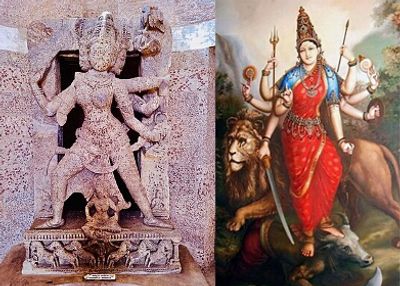
Hindu Durga vs. Buddhist Female Icons Marici, Tara, and Dakini
Goddess Durga was created through the combined, radiant energies of all Hindu gods—primarily Shiva, Vishnu, and Brahma—to destroy the invincible buffalo demon Mahishasura, who could not be killed by any man. Born fully formed as a powerful warrior, she emerged from this light, armed with weapons gifted by the gods. Durga is copied from the Buddhist Tara.
Marici is a Buddhist deity (Deva), as well as a Bodhisattva associated with light and the Sun. By most historical accounts Marici is considered a goddess. Some of the earliest iconographies of Marici are found in India and Tibet, particularly near the ancient port city and Buddhist site Salihundam of Andhra Pradesh, where Marici is depicted as riding on a chariot pulled by seven horses in a manner similar to Surya (sun deity with goddesses Usha and Chaya). In Mahayana Buddhist texts, Marici is the goddess of dawn, one introduced by the Buddha at Shravasti. In China, Marici is worshiped as both a Buddhist and Taoist deity. She is highly revered in esoteric Buddhism.
Tara shares her protective role. One specific form of Tara even rides a lion and is invoked to save devotees from evil. In Buddhism, Tara (Sanskrit for "Star" or "Saviouress") is a fully enlightened female Buddha and one of the most revered figures in Tibetan (Vajrayana) Buddhism.
Dakini (Sanskrit: ḍākinī; Tibetan: khandroma) is a female embodiment of enlightened energy, often referred to as a "sky dancer." They represent the wisdom principle—specifically the realization of emptiness (sunyata)—and are essential figures in the Tibetan Vajrayana (Tantric) path for cutting through mental confusion and obstacles to enlightenment.