Bodhi Scientific
  • Home
  • Events
  • Photos
  • Videos
  • Dhamma
    • What Is Dhamma?
    • The Historical Buddha
    • Language and Script
    • Ashoka and the Dhamma
    • The Indus Valley
    • Intellectual Civilization
    • Correcting Narratives
  • Q&A
    • Part I
    • Part II
  • Hinduism
    • A Copy & Paste Religion
    • Myths
    • Hinduism's Survival
  • schools
    • Schools
    • Shunyavada
    • Yogachara
  • More
    • Home
    • Events
    • Photos
    • Videos
    • Dhamma
      • What Is Dhamma?
      • The Historical Buddha
      • Language and Script
      • Ashoka and the Dhamma
      • The Indus Valley
      • Intellectual Civilization
      • Correcting Narratives
    • Q&A
      • Part I
      • Part II
    • Hinduism
      • A Copy & Paste Religion
      • Myths
      • Hinduism's Survival
    • schools
      • Schools
      • Shunyavada
      • Yogachara
Bodhi Scientific
  • Home
  • Events
  • Photos
  • Videos
  • Dhamma
    • What Is Dhamma?
    • The Historical Buddha
    • Language and Script
    • Ashoka and the Dhamma
    • The Indus Valley
    • Intellectual Civilization
    • Correcting Narratives
  • Q&A
    • Part I
    • Part II
  • Hinduism
    • A Copy & Paste Religion
    • Myths
    • Hinduism's Survival
  • schools
    • Schools
    • Shunyavada
    • Yogachara

shunyavada

Shunyavada, often translated as the "Doctrine of Emptiness," is a foundational philosophical school of Mahayana Buddhism. It posits that all phenomena are "empty" (shunya) of intrinsic, independent existence (svabhava) because they arise only through dependent origination. Shunya meaning zero in English. 

Core Concepts of Shunyavada

  • Emptiness (Shunyata): This does not mean "nothingness" or nihilism. Rather, it means things lack a permanent, fixed essence. A table, for instance, is "empty" because its existence depends entirely on wood, labor, and a human concept of "table."
  • The Middle Way: Shunyavada follows the "Middle Path" between two extremes: eternalism (believing things have a permanent soul/essence) and nihilism (believing nothing exists at all).
  • Two Truths Doctrine: It distinguishes between "conventional reality" (how we experience the world daily) and "ultimate reality" (the direct realization of emptiness). 

History and Major Figures

  • Nagarjuna (c. 150 CE): He is the most systematic expounder of this school. His foundational work, the Mūlamadhyamakakārikā, uses a unique dialectical method called Prasanga to reveal internal contradictions in opposing views without asserting a final positive "position."
  • Origin: While Nagarjuna refined it, the seeds of the doctrine are found earlier in the Prajnaparamita Sutras.
  • Madhyamaka School: Shunyavada is the central tenet of the Madhyamaka school of Buddhism. 

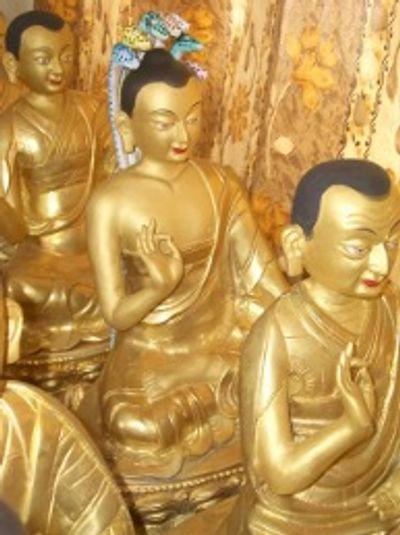
Nagarjuna (seen in image to the right) is widely regarded as a “second Buddha,” as well as one of the greatest thinkers in the history of Asian philosophy. Credited with the founding of the Madhyamika (Middle Way) school, he and his main disciple, Aryadeva, provided the Mahayana tradition with a sophisticated and enduring philosophical framework. The Madhyamika is also referred to as Sunyavada, the “doctrine of emptiness (sunyata).” Nagarjuna’s inquiry started with the traditional Buddhist definition of emptiness as an absence of svabhava, and took him to an equation of emptiness with dependent origination (pratityasamutpada), a doctrine which the Buddha had put forward, but left relatively undeveloped. Dependent origination is also the philosophical concept underpinning the path of practice of the Two Truths, a Mahayana reformulation of the Middle Way.


We know very little for certain about Nagarjuna’s life circumstances and the works he wrote. One of the reasons for this is that there seems to have been at least two, perhaps three, Nagarjunas, a philosopher who lived in the Andhra region in the second to third centuries CE, a tantric adept who lived around 400 CE and an alchemist who lived in the 7th century. 
Nagarjuna the philosopher (c. 150-c. 250 CE, based on his association with Satavahana king Yajna Sri Satakarni) is said to have lived in Sriparvata (present-day Nagarjunakonda [see picture to the right]), a mere 160 km from the site of the Amaravati Monastery, where the first Prajnaparamita Sutra is believed to have been composed. In fact, the region, where Buddhism had been introduced by Asoka, has recently attracted the attention of scholars, whose research papers have been published in Buddhism in the Krishna River Valley of Andhra. The introduction of this publication starts with the claim that, “such pivotally important Mahayana Buddhist thinkers as Nagarjuna, Dignaga, Candrakirti, Aryadeva and Bhavavika, among many others, formulated their theories while living in Buddhist communities in Andhra.”

Among the many works associated with an author named Nagarjuna, six have been assessed to be the works of Nagarjuna the philosopher, and among these, scholars have focused on the Mulamadhyamakakarika (Fundamental Verses on the Middle Way), often using later commentaries by Candrakirti (c. 600 – c. 650 CE) and even the much later Tibetan Tsong kha pa (1357–1419) as additional resources.


With a whole volume dedicated to a presentation of Madhyamaka, Westerhoff goes in some depth into the meaning of svabhava, which he leaves untranslated because “there is no single term used in Western philosophy that covers the different aspects of its meaning in the Madhyamika context in a satisfactory manner.”


Svabhava is indeed “a very complex concept” combining different aspects which Westerhoff, following a classification proposed by Candrakirti, differentiates into three distinct understandings. He writes: “The first is the understanding of svabhava as essence, as a property that an object cannot lose without ceasing to be that very thing.” It is “the specific characterizing property of an object.” It has a cognitive function in as much as “it provides a procedure for drawing a line between a variety of objects with shared qualities and thereby allows us to tell them apart.” The second understanding is “as substance, as something that does not depend on anything else; and the third is what I have called absolute svabhava, as a property that is regarded as the true or final nature of things.” These three senses will be referred to by “the terms essence-svabhava, substance-svabhava and absolute svabhava.”


Westerhoff , however, readily accepts that, even as substance-svabhava figures most prominently in Nagarjuna’s thought, a cognitive dimension remains, in so far as “the notion of svabhava is regarded as a conceptual superimposition, as something that is automatically projected onto a world of objects that actually lack it. Unlike the notion of substance, svabhava is not just a theoretical concept of ontology but rather a cognitive default, an addition that the mind unwittingly makes when trying to make sense of the world.” Since svabhava is a “cognitive default, “a mistaken superimposition, it is never enough to just explain that “things” do not really exist in the way they appear to exist. I would add here that this “cognitive default” is rooted in what the Buddha regarded as our tendency to become attached to things, reflecting a need for solidity and permanence, forever frustrated by the certainty of death. To overcome both the cognitive default and the trap of attachment, “we will also have to train ourselves out of the automatic habit of projecting svabhava onto a world that lacks it.” We can now see why the Prajnaparamita sutras, which were meant to be learned by heart and recited, are so repetitive: Their aim was to block off the automatic superimposition of svabhava.


Substance-svabhava, which is translated as “intrinsic, or inherent existence” is “an indication of ontological status. To have svabhava means to exist in a primary manner, unconstructed and independent of anything else.” A substance is that which “stands by itself,” independently of anything else. For the Buddhist, to see “things” as empty of inherent existence is to see them as conceptual constructs, dependent on our minds, and therefore illusory in the sense of not existing objectively outside, independently of our minds.


Reference:

Jan Westerhoff – Nagarjuna’s Madhyamaka – A Philosophical Introduction (2009)

Paul Williams – Mahayana Buddhism: The Doctrinal Foundations 2nd edition (2009) 


Copyright © 2026 Bodhi Scientific - All Rights Reserved.

Powered by

This website uses cookies.

We use cookies to analyze website traffic and optimize your website experience. By accepting our use of cookies, your data will be aggregated with all other user data.

Accept